
Can the Uniswap Foundation's massive investment plan solve the token value capture dilemma?



Original Title: Uniswap Foundation votes on a massive $165.5m USD funding.
Original Author: Ignas
Original Translation: Tim, PANews
The Uniswap Foundation has voted on a $165.5 million USD investment plan, but why?
Because the performance of Uniswap v4 and Unichain post-release has fallen far short of market expectations.
In over a month:
· Uni v4's Total Value Locked (TVL) is only $85 million
· Unichain's TVL is only $8.2 million
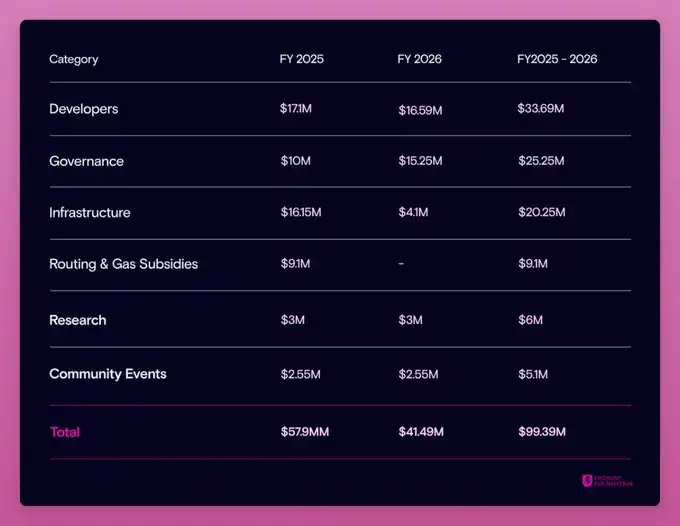
To drive growth, the Uniswap Foundation has proposed allocating $165.5 million in funding towards the following:
· $95.4 million for Grants (developer initiatives, core contributors, validators);
· $25.1 million for Operations (team expansion, governance tooling);
· $45 million for Liquidity Incentives.
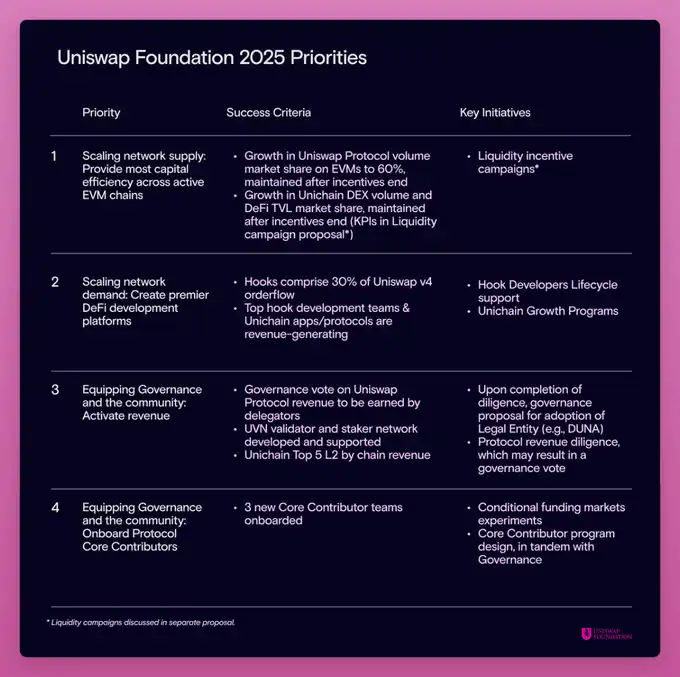
As you can see, Uni v4 is not just a DEX but also a liquidity platform, and Hooks are applications built on top of it.
Hooks are meant to drive the ecosystem growth of Uni v4, hence the need to accelerate this process through a funding initiative.
A breakdown of the funding budget:
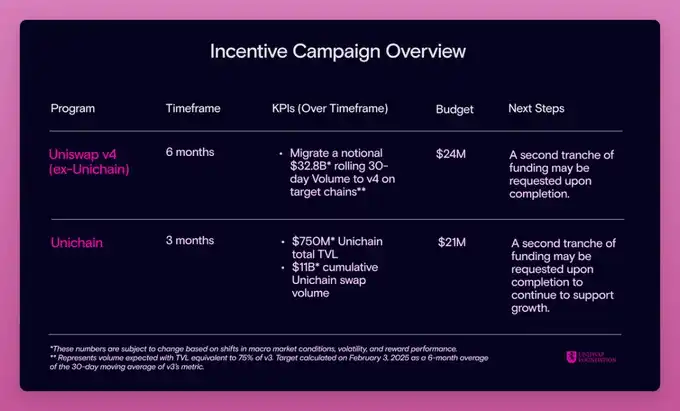
The $45 million Liquidity Provider (LP) Incentives will be used as follows:
· $24 million (distributed over 6 months): To incentivize liquidity migration from other platforms to Uni v4;
· $21 million (distributed over 3 months): To drive Unichain's Total Value Locked (TVL) from the current $8.2 million to $750 million.
On the other hand, Aerodrome mints approximately $40-50 million worth of AERO tokens per month for Liquidity Provider (LP) incentives.
The proposal has passed the temperature check phase but still faces some criticism:
Amidst industry shifts, Aave proposes a weekly buyback of $1 million worth of AAVE tokens, Maker plans a monthly buyback of $30 million, and UNI holders are likened to a "cash cow" that has never had its token value captured.
UNI tokens do not enable a fee-sharing mechanism, yet Uniswap Labs has earned $171 million over two years through frontend fees.
The key to the whole system lies in Uniswap's organizational design:
· Uniswap Labs: Focuses on protocol tech development;
· Uniswap Foundation: Drives ecosystem growth, governance, and funding initiatives (such as grants, liquidity incentives).
Quite a savvy legal team.
Aave and Maker have established a closer alignment of interests with token holders, and I don't understand why Uniswap's frontend fees cannot be shared with UNI holders.
In conclusion, other criticisms mainly revolve around the core team's high salaries, Gauntlet's responsibility for liquidity incentive execution, and the establishment of a new centralized DAO legal structure (DUNA).
As a small governance representative for Uniswap, I have voted in favor of this proposal, but I still have significant concerns about the future of UNI holders: the incentive mechanism has failed to align with holders' interests.
However, I am a loyal fan of Uniswap and highly appreciate its driving role in the DeFi space. The current stagnation of Uni v4 and Unichain is very concerning, and they need to introduce incentive measures to foster development.
The next Uni DAO vote should focus on the UNI token's value-capture mechanism.
You may also like

Morning Report | CoinEx becomes a key hub for Iran to evade sanctions, involving over $3.8 billion in funds; Kalshi seeks a new round of financing, with a valuation potentially rising to $40 billion

Why do cryptocurrency projects always like to change their names?

From the white-haired stock god to the billionaire fund mogul, the smart people shorting Nvidia are all getting rich using the same framework

Morning News | The draft amendment to the People's Bank of China Law aims to clarify the legal status of digital renminbi; South Korea will transfer about 40 unregistered virtual asset service providers to law enforcement agencies

The cryptocurrency industry has entered the "Show Me" era: merely relying on vision is no longer enough
Interpreting the Ethereum Foundation's new structure: Reaffirming self-sovereignty amid institutional trends
Former SpaceX engineer reconstructs the financial execution system using first principles

Tidal Investment: We still have a positive outlook on the AI industry chain, but the reasons have changed

Standard Chartered Bank sings a 50x rhapsody again, aiming for AAVE to reach 3500 USD

The interim executive director of the Ethereum Foundation speaks out: What is our mission?
Why does OKX want to start a new company with the parent company of the New York Stock Exchange?

Why Is PAXG Price Different From Gold? 5 Reasons Crypto Traders Should Know

WEEX OpenAPI 101: 5 Powerful Modules, AI Trading Tools, and Grab Up to 70% Revenue Opportunities
Learn how WEEX OpenAPI connects traders, developers, AI agents, and trading platforms. Discover WEEX API features, Binance-compatible integration, automated trading workflows, revenue opportunities, and ecosystem possibilities.

Interview with NDV Founder Jason Huang: Popping the AI Bubble and the Myth of Microstrategy, Seeking the Ultimate Ace in the Crypto Market

Morning Report | Former Ethereum Foundation researcher establishes Ethlabs; EU Parliament Economic Committee passes digital euro regulatory proposal

Dragonfly partner Haseeb: The fastest-growing companies in the future may all be stuck at 149 people

How xBubble Breaks the Deadlock in VC's Heavy Investment in the OPC Economy

The encrypted unicorn Blockstream is deeply embroiled in a serious fraud case
Morning Report | CoinEx becomes a key hub for Iran to evade sanctions, involving over $3.8 billion in funds; Kalshi seeks a new round of financing, with a valuation potentially rising to $40 billion
Why do cryptocurrency projects always like to change their names?
From the white-haired stock god to the billionaire fund mogul, the smart people shorting Nvidia are all getting rich using the same framework
Morning News | The draft amendment to the People's Bank of China Law aims to clarify the legal status of digital renminbi; South Korea will transfer about 40 unregistered virtual asset service providers to law enforcement agencies
The cryptocurrency industry has entered the "Show Me" era: merely relying on vision is no longer enough
Interpreting the Ethereum Foundation's new structure: Reaffirming self-sovereignty amid institutional trends


