
Predicting a Market Crash in Advance? Warren Buffett's Credibility Is Still on the Rise

![EverRise [old]](https://s2.coinmarketcap.com/static/img/coins/64x64/10548.png)


Original Article Title: "Predicting a Market Crash in Advance? The Shine of Stock God Buffett Continues to Rise"
Original Article Author: Mary Liu, BitpushNews
“Be fearful when others are greedy and greedy when others are fearful.” This simple yet profound wisdom comes from the mouth of Warren Buffett, a 94-year-old billionaire investor.
This figure, known as the "Oracle of Omaha" market forecaster, once again demonstrated the value of this adage with his precise judgment—he seems to have foreseen long ago that Donald Trump's policies could bring a storm to Wall Street.
Yesterday, Wall Street experienced a "Black Monday," with a significant market downturn, confirming Buffett's "prediction." Investor concerns about an economic recession intensified, triggering panic selling in the market. The S&P 500 index plummeted more than 9% from its historical high on February 19, nearing a "correction" (defined as a drop of 10% or more from the previous high), with only Buffett's net worth rising against the trend among the Top 10 richest people.
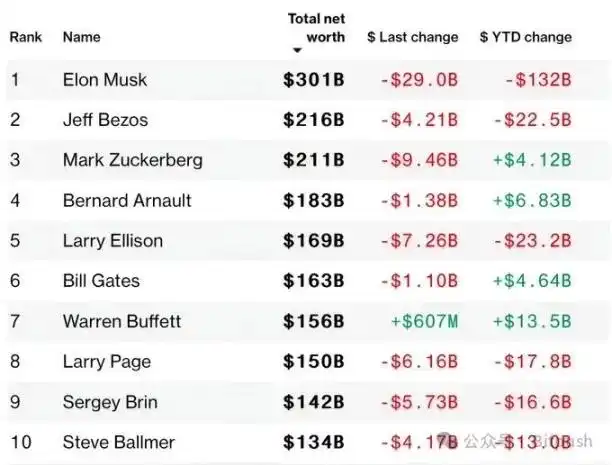
For Buffett, the market's plunge undoubtedly once again proved the foresight and correctness of his investment strategy.
Positioning Ahead of the "Trump Recession"
Berkshire Hathaway, under Buffett's leadership, has been steadily reducing its stock holdings in recent years, amounting to billions of dollars, and instead accumulating massive amounts of cash.
Data shows that Buffett has been selling more stocks than buying for nine consecutive quarters, including significantly reducing stakes in several well-known companies. As early as last year, even before the Trump administration took office, Buffett began selling off most of his Apple stock and reduced investments in Bank of America and Citigroup.
Over the past few months, Berkshire Hathaway's cash reserves have soared to an astonishing $334 billion, accounting for more than one-third of its entire investment portfolio. Surprisingly, this cash reserve size exceeds the total market value of all companies listed on the UK's FTSE 100 index.
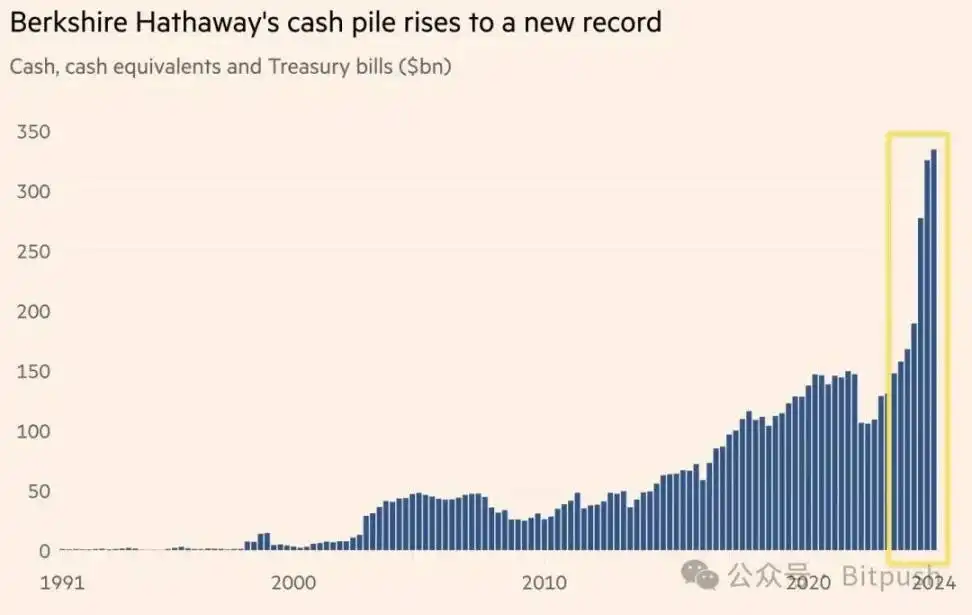
Buffett is a typical long-term investor who prefers to sit on the sidelines, patiently waiting for the best opportunity, rather than blindly chasing market hotspots and the latest trends.
Despite holding a huge amount of cash, Buffett explicitly denies the claim that he "prefers cash over stocks." In his February shareholder letter, he emphasized, "While some commentators continue to view Berkshire's enormous cash position as a mistake, you should be aware that your company's most important asset, by far, is its insurance operation, not its investment portfolio. We differ from some commentators in that view."
Panic Spreads as Buffett's Adage Once Again Rings True
Amidst market turbulence, it may be worthwhile to once again heed the advice of this investment legend.
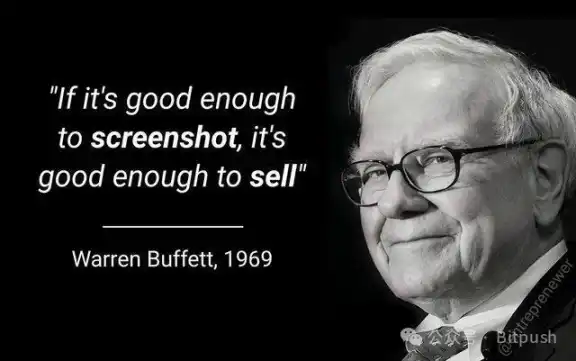
In his 2017 letter to shareholders, he wrote, "In the short run, the market is a voting machine, but in the long run, it is a weighing machine." However, he quickly added that if a significant decline were to occur, remember the following lines from Rudyard Kipling's classic poem, written around 1895:
"If you can keep your head when all about you are losing theirs . . . If you can wait and not be tired by waiting . . . If you can think – and not make thoughts your aim . . . If you can trust yourself when all men doubt you . . . Yours is the Earth and everything that’s in it."
Why Does Keeping a Cool Head Pay Off?
It's worth noting that Buffett is referring to a major drop in the U.S. stock market, such as the bear market from 2007 to 2009, during which the S&P 500 index lost over 50% of its value. In comparison to that period, the current pullback experienced by investors is far from those tumultuous times.
In fact, market pullbacks are a normal part of the capital markets. Data from Bedell Frazier Investment Counselling shows that since 1980, the S&P 500 index has experienced 21 declines of 10% or more, with an average intra-year drop of 14%.
Indeed, during times of market turmoil, investors often find it challenging to predict the future accurately. Just as Buffett wrote in 2017:
"No one can tell you when these (plunges) will happen. The light can at any time go from green to red without any yellow light to cushion the transition."
Buffett firmly believes that periods of market distress present "extraordinary opportunities." Historical data has repeatedly shown that the market will eventually recover its upward trajectory. What value investors need to do is simply wait patiently and take full advantage of the market's downturn to "pick up" undervalued assets.
Data from Hartford Funds shows that since 1928, the average bear market in the U.S. has lasted less than 10 months — a bear market is defined as a decline of 20% or more from a recent high. For investors planning for investments spanning decades, the impact of a bear market is but a brief moment in the long river of investment.
Therefore, even in the midst of bear market panic and agony, always keep your eyes on the ultimate "prize" — your long-term financial goal that you are striving for. Continuing to invest during a market downturn is akin to actively buying during a stock discount sale. As long as you adhere to a diversified investment strategy, the deeper the stock prices fall, the better the "bargain" you will get.
Buffett's investment philosophy, echoed in a famous quote from his 2009 shareholder letter, emphasizes the importance of seizing investment opportunities when the market is depressed: "Opportunities come infrequently. When it rains gold, put out the bucket, not the thimble."
You may also like

Morning Report | CoinEx becomes a key hub for Iran to evade sanctions, involving over $3.8 billion in funds; Kalshi seeks a new round of financing, with a valuation potentially rising to $40 billion

From the white-haired stock god to the billionaire fund mogul, the smart people shorting Nvidia are all getting rich using the same framework

Why do cryptocurrency projects always like to change their names?

Global Launch: As predictions become the most scarce asset in the AI era, Manadia is defining the next generation of the value internet

Who is footing the bill for the $64 billion accounting frenzy?
I never expected that the first application of AI x Crypto would be in security auditing

What is your view on Binance's competitive advantages?

ETH has entered a non-consensus phase, and the turning point is approaching!
The shift in the cloud of the air: from despising stablecoins a year ago to the high-profile entry of capital today
The survival dilemma of small and medium exchanges behind the withdrawal anomalies exposed by AscendEX

Why Is Bitcoin Falling Below $60K? 5 Key Market Drivers Explained
Bitcoin has dropped sharply amid ETF outflows, Strategy stock weakness, AI stock rallies, and changing Fed expectations. Explore the key forces driving BTC’s latest correction and what traders should watch next.

Bitcoin vs. Gold in 2026: Which Asset Performs Better in Different Markets?

Morning News | The draft amendment to the People's Bank of China Law aims to clarify the legal status of digital renminbi; South Korea will transfer about 40 unregistered virtual asset service providers to law enforcement agencies
The cryptocurrency industry has entered the "Show Me" era: merely relying on vision is no longer enough

Interpreting the Ethereum Foundation's new structure: Reaffirming self-sovereignty amid institutional trends
Former SpaceX engineer reconstructs the financial execution system using first principles
Standard Chartered Bank sings a 50x rhapsody again, aiming for AAVE to reach 3500 USD

Tidal Investment: We still have a positive outlook on the AI industry chain, but the reasons have changed
Morning Report | CoinEx becomes a key hub for Iran to evade sanctions, involving over $3.8 billion in funds; Kalshi seeks a new round of financing, with a valuation potentially rising to $40 billion
From the white-haired stock god to the billionaire fund mogul, the smart people shorting Nvidia are all getting rich using the same framework
Why do cryptocurrency projects always like to change their names?
Global Launch: As predictions become the most scarce asset in the AI era, Manadia is defining the next generation of the value internet
Who is footing the bill for the $64 billion accounting frenzy?
I never expected that the first application of AI x Crypto would be in security auditing


